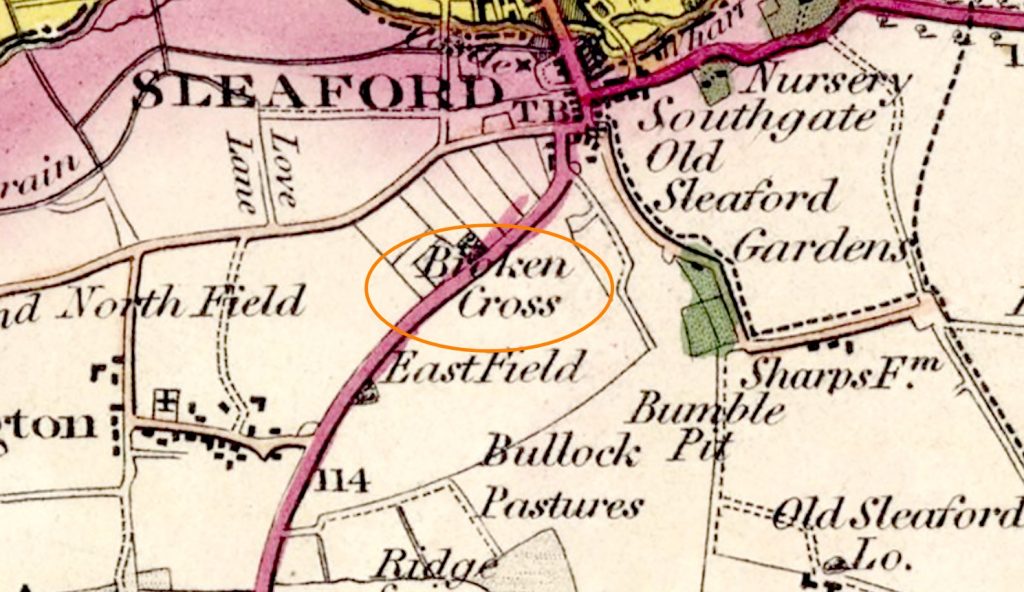
There are records of TWO LOST CROSSES at Quarrington
which we shall call (1) and (2)
White’s Lincolnshire Directory of 1856 (p. 549), records the following: There were in the parish two ancient crosses, one of which (1) is still standing (five feet high) at the north end of Mareham Lane and the site of the other (2) is marked by a small plantation, in Quarrington field, on the spot called in old writings ‘Stump Cross Hill’.
Trollope, writing in 1872, states: ‘Two stone crosses formerly existed in this parish. The shaft of one of these (1), about five feet high, stood near the tollgate on the Sleaford and Folkingham road. Half a mile nearer the village was the other (2), on a spot called after it – Stump Cross Hill – marked by a small plantation. Latterly its circular head alone remained which had a cross carved on both its sides.’ Davies (1913) repeats Trollope’s statement.
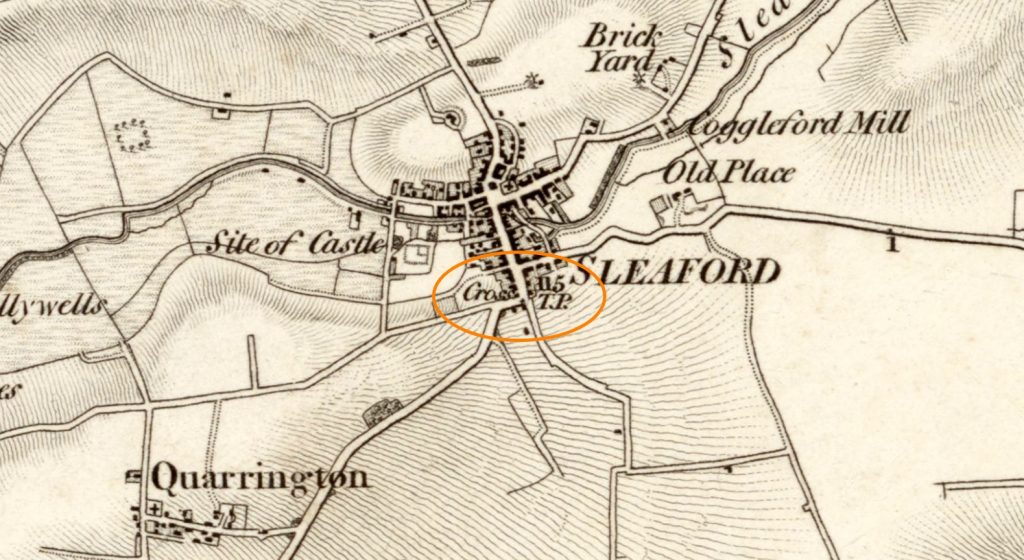
Cross (1)
The 1824 one inch O.S. map shows a ‘Cross’ marked at the junction of Southgate and Grantham Road/London Road on the south side of the junction. It is also marked TP for the toll bar of a turnpike road and would be a logical place for a boundary cross. This area was completely altered in 1857 when the railway line with station and level-crossing was constructed at this road junction. No trace of the cross survives today.
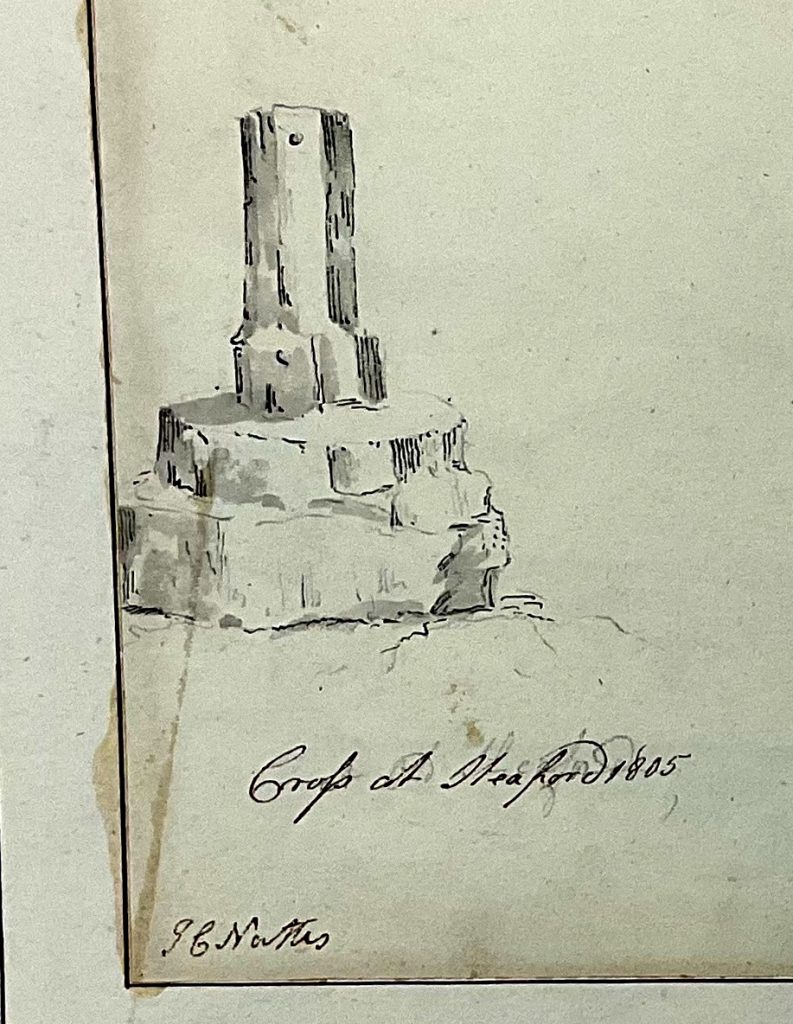
C J Nattes drew this cross in 1805 while it still stood – He records it as ‘Cross at Sleaford, 1805’. Arguably it was in Sleaford, but was probably a Sleaford/Quarrington boundary cross.
Cross (2)
The other lost Quarrington cross, was said to be located on Stump Cross Hill. This place name (a clear indication of a standing cross location) still exists as a part of London Road in Quarrington parish. The circular cross head mentioned in White’s (and repeated by Trollope) cannot now be located.
Bryant’s county map of 1828 shows ‘Broken Cross’ on the London Road. Trollope, writing in 1872 notes its site was ‘marked by a small plantation’ and later maps show ‘Goodson’s Holt’ on this part of the road. There is still a small copse there to this day, although the whole area around is now infilled by housing.