Ampney Crucis is a village in the Cotswolds of Gloucestershire. There are three Ampneys, all named after the stream (the Ampney Brook) and the ‘Crucis’ element probably comes from the fact that the parish church was dedicated to the Holy Rood (a older name for crucifix or cross). Some sources suggest that the Crucis element derives from the rather fine churchyard cross to be found there, but the place name is given in Domesday, which predates the standing cross by a couple of centuries.
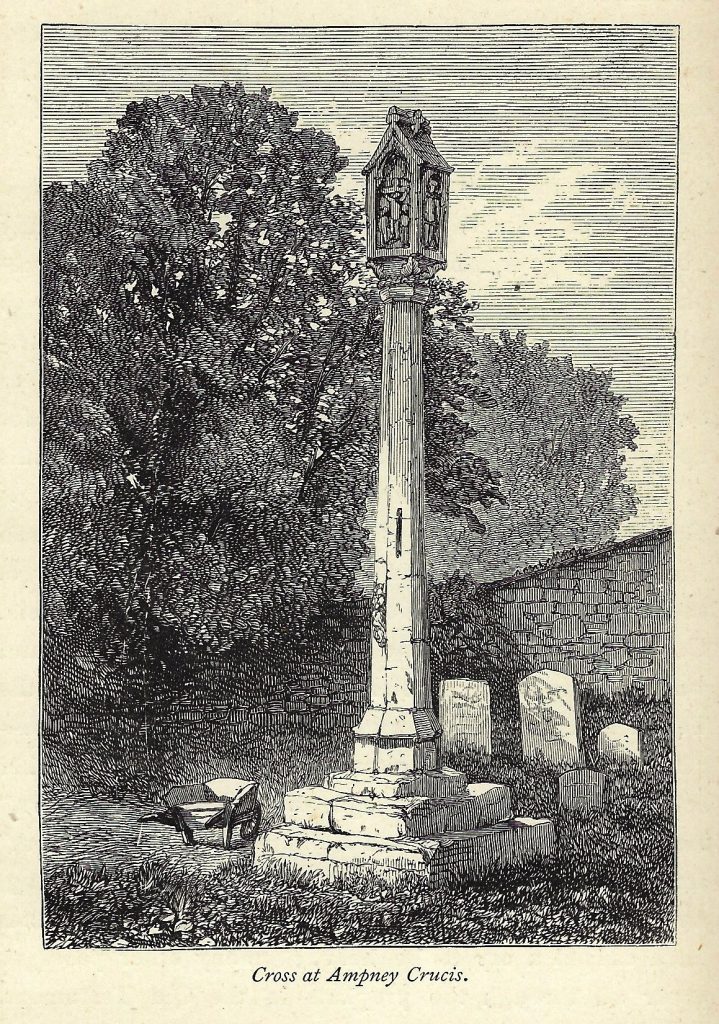
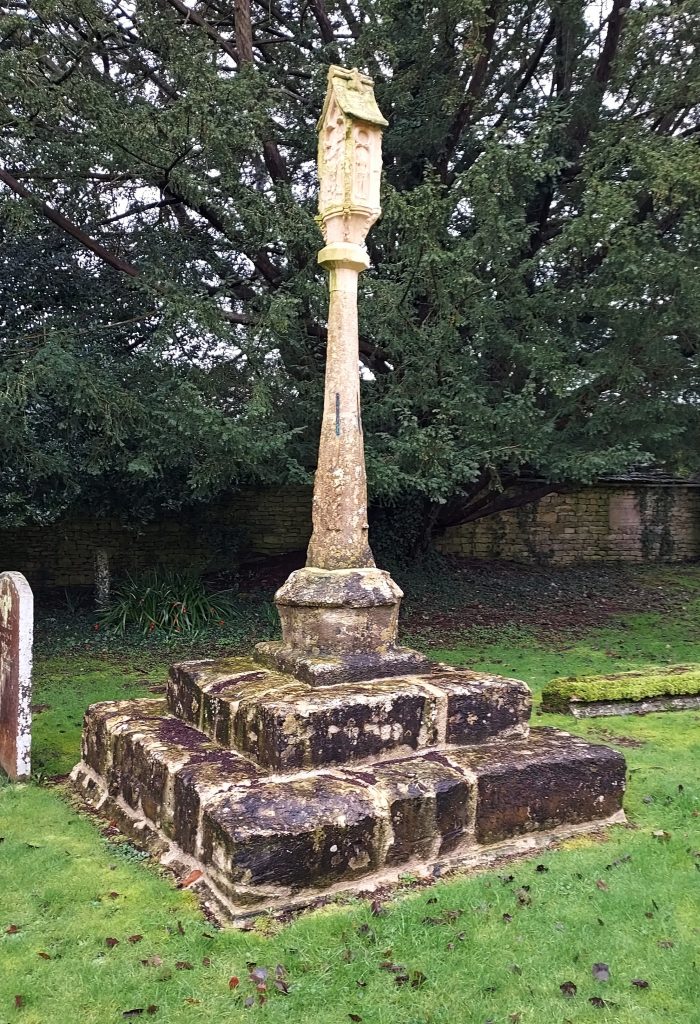
Ampney Crucis cross has an interesting history and is often illustrated in books and articles on crosses, including this fine engraving below by Rimmer (p.128). The cross had a lantern head with four sculpted figures and was seemingly duly beheaded at the Reformation. But the detached head was retained – perhaps hidden? in the stairway to the (now redundant) rood loft stairs. It was rediscovered by Charles Pooley FSA in 1860 and restored to its surviving shaft. It is a classic case of churchwarden conservatism and it is probable many crossheads were similarly hidden, or buried, in he hope of restoration some day.
Drawing of the restored Ampney Crucis churchyard cross by Alfred Rimmer
The story of the cross is told by Charles Pooley in his book, Notes on the Old Crosses of Gloucestershire (1868). He says:
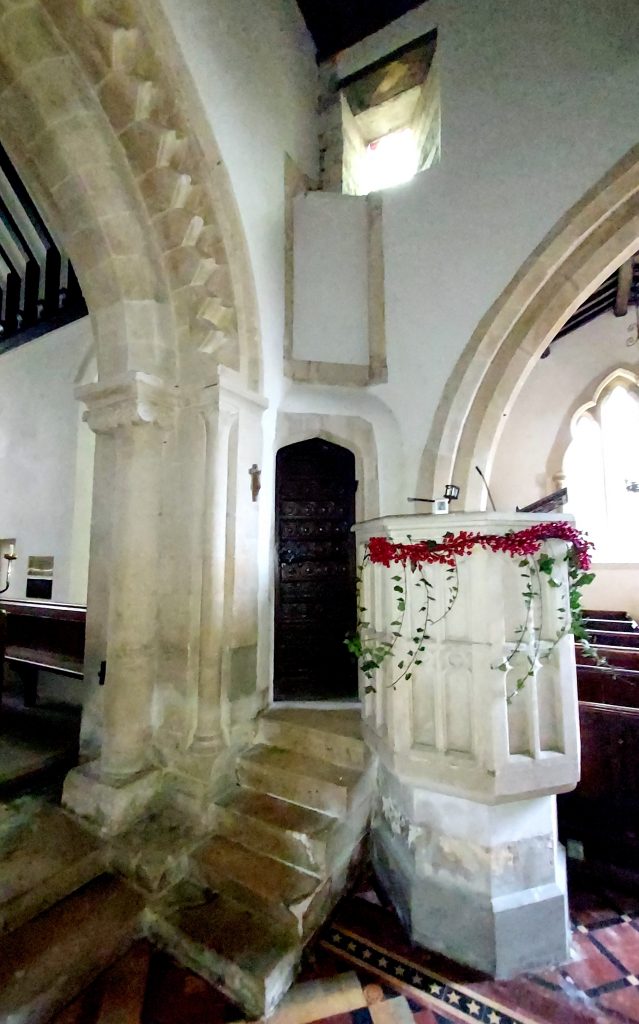
Under a heap of rubbish deposited in a small recess on the south side of the church of Amney Crucis, the doorway of an ancient rood staircase, I was fortunate enough to find the head of the old Cross, whose base and shaft stand in the adjoining churchyard.
The name of this parish is properly Amney of the Holy-Rood. It is commonly called Amney Crucis. … A church was built here before the time of the conquest, but the cross is some centuries’ later date. It consists of two steps measuring respectively 7 ft 6 in and 5 ft square, a handsome octagonal socket, hewn out of a solid block of stone, having its upper face worked into a deep drip moulding, and a tapering octagonal shaft formed of two stones cemented together by an iron bracket, its base squared by broaches of an ornamental character and fixed with lead into the mortice. The total height is about 10ft.
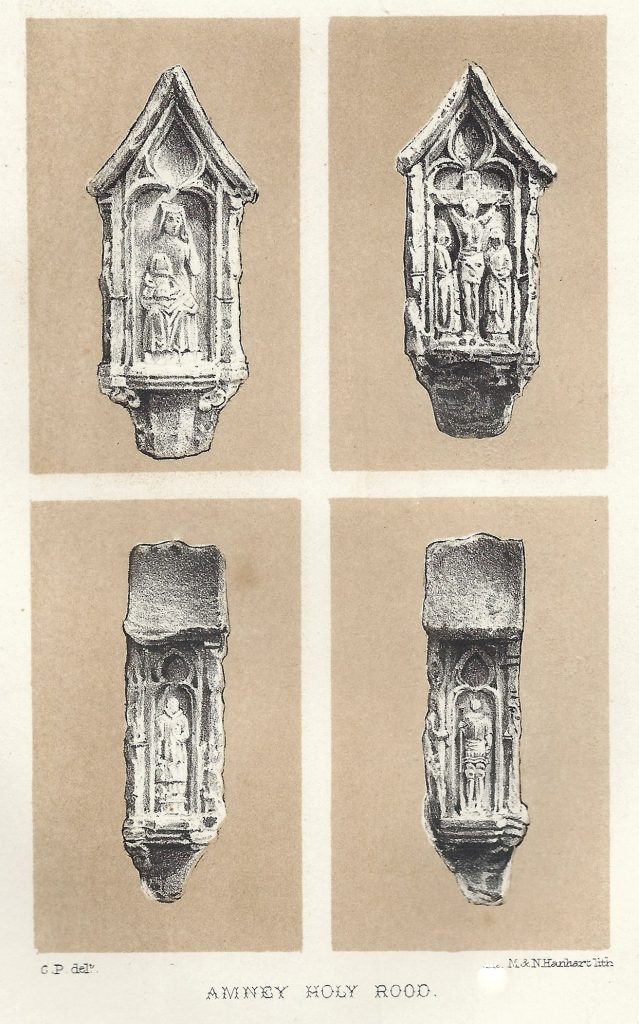
The head is in good preservation. Perhaps after having been overthrown it was carefully hid away in the church, with the view of being produced as a warranty at a future time …. The head of the cross is divided into four niches, supported by richly carved Gothic buttresses, containing figure sculptured in relief.
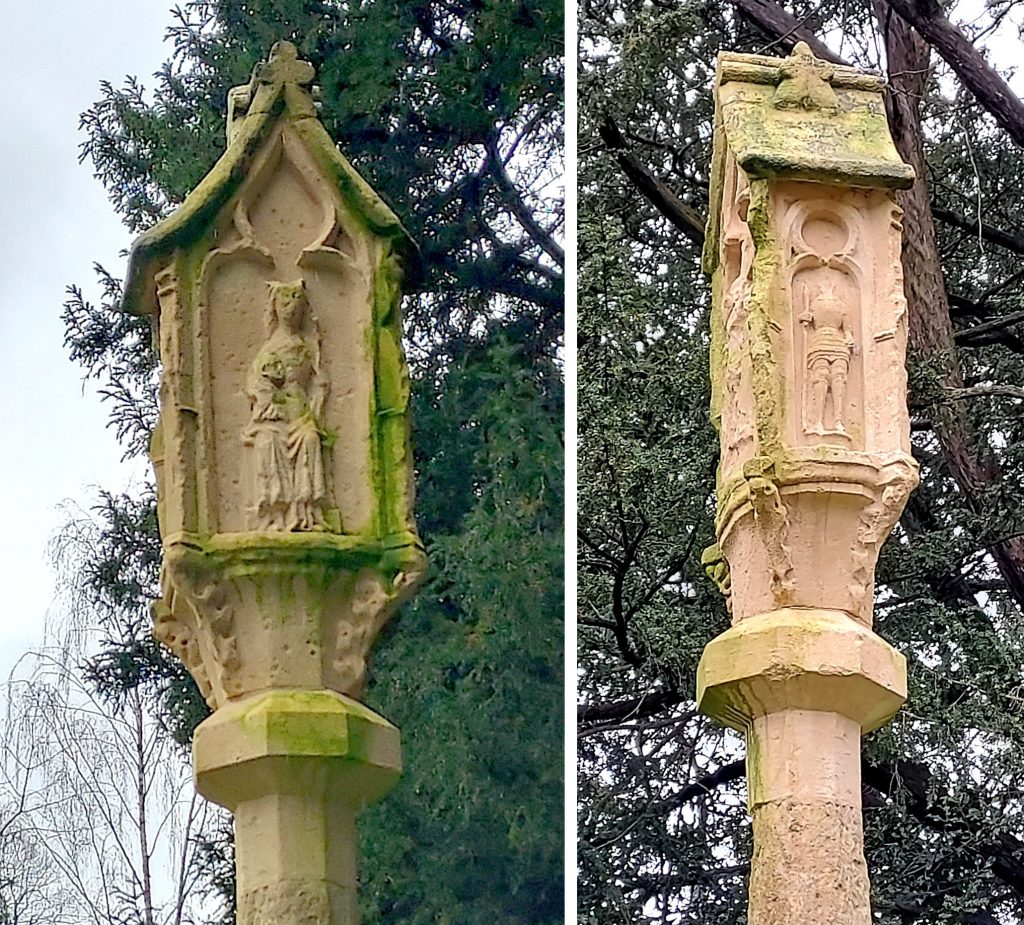
The nicely chiselled Virgin and Child, which occupies one of the large niches, is supposed to have some reference to the adjoining parish of Amney St Mary, but neither Amney St Mary nor Amney St Peter were held by the same abbey as Amney Holy Rood [which was] dependent on Tewksbury Abbey … the infant is placed on the right knee, the reverse of the usual custom of mothers. The left arm of the Virgin is mutilated, but looks as if it had been raised in the act of benediction. Her costume is a close-fitting bodice, laced in front, and a tunic fastened by a cross patee on the breast.
The foor faces of Ampney Crucis cross, drawn by Pooley – The drawing is important as it shows the cross head before ‘restoration’
In the second niche is a carving of a complete Rood, namely, – the crucifix, wit the figures of S. John and the Virgin placed on each side. St John is leaning on a staff. … The two remaining niches are filled, one by the figure of an individual of the sacerdotal order, dressed in canonicals, holding in his right hand a plan, and a book in his left, which I take to be intended for no other than Gyraldus, first abbot of Tewksbury; the other by the effigy of a Knight in armour, grasping in his right hand a spear reversed. …
Pooley notes: “This cross has since been restored in good taste by the Rev Canon Howman”, however, viewing the cross head today it seems that the figures have been recut, not merely restored.
Two faces of the Ampney Crucis cross head – Mary and Child (left) and St John (right)
The doors to the rood stairway in Amney Crucis church – it was in ‘a heap of rubbish’ in the lower doorway, that Charles Pooley found the lost head of the churchyard cross.
The restored Ampney Crucis cross as it appears today